- Updated Date

Mohamed HabbatAuthor

Mastering Solidity 0.8: Navigating Native Checked Arithmetic and Safe Smart Contract Development
Share:



Introduction
The world of blockchain development is constantly evolving, and staying updated with the latest advancements is crucial for any developer, unfortunatelly most developers they don't know what each new version of solidity brings to the table, and they keep using the old way which usualy wasting gas redoing a check that the compiler already did. One significant change that often goes unnoticed is the introduction of native checked arithmetic in Solidity version 0.8 and above.
This shift from earlier versions, where developers relied on tools like OpenZeppelin's Counter class to ensure safe arithmetic operations, marks a significant evolution in the language's capabilities. This article delves into how this feature has rendered the Counter class obsolete when using OpenZeppelin 3.x and above, a shift from the older versions where additional measures were necessary to ensure safe arithmetic operations.
The Evolution of Solidity and its Impact on Safe Arithmetic
Solidity's journey has been marked by continuous improvements aimed at enhancing security, efficiency, and developer convenience. Early versions of Solidity laid the groundwork for Ethereum smart contract development, focusing on basic functionalities and syntax similar to JavaScript. As the ecosystem grew, the language evolved to address the increasing demands of complex decentralized applications.
Early Versions (Pre-0.4.x):
- Focus on basic functionalities for Ethereum smart contracts.
- Syntax influenced by JavaScript, emphasizing ease of use for web developers.
Version 0.4.x:
- Introduction of advanced types and improved memory management.
- Enhanced flexibility in data handling, catering to more complex contracts.
Version 0.5.x:
- Increased emphasis on type safety and error handling.
- Aimed to bolster security in smart contract development.
Version 0.6.x:
- Custom error handling and NatSpec comments introduced.
- Enabled writing more robust and user-friendly code.
Version 0.7.x:
- Streamlined syntax and additional language features for improved efficiency.
- Continued focus on simplifying developers' experience.
Version 0.8.x (Major Leap):
- Introduction of native checked arithmetic, significantly enhancing security.
- Reduced dependency on external libraries for arithmetic operations.
- Marked a shift towards inherent security in smart contract coding.
The Era Before Solidity 0.8: Necessity of Counter Class
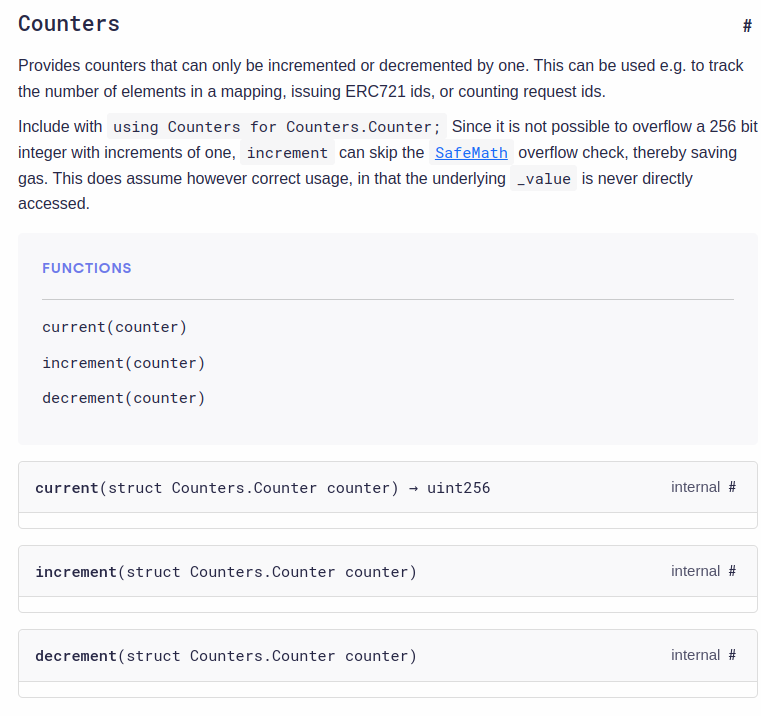
In earlier versions of Solidity, particularly those below 0.8.0, developers faced the challenge of arithmetic overflows and underflows - situations where calculations exceed the maximum or minimum limits of a data type, leading to errors or vulnerabilities. OpenZeppelin 3.x, a widely used framework for secure smart contract development, introduced the Counter class to address arithmetic overflow/underflow issues. The Counter served as a safeguarded object that could be incremented in an "unchecked" manner, eliminating the risk of overflow.
Transition to Solidity 0.8 and Beyond: Native Checked Arithmetic
With the release of Solidity 0.8.0, the landscape changed significantly. This version introduced native checked arithmetic, where the compiler itself detects and handles any arithmetic overflow/underflow vulnerabilities, it throws an error, preventing unintended behavior. This development meant that the additional layer of security provided by the Counter class became redundant. As a result, in the latest major release of OpenZeppelin (version 5.0), the Counter class was removed, reflecting the updated capabilities of Solidity.
Understanding the Limits: Scenarios Where Overflow/Underflow Can Still Occur in Solidity 0.8
Despite the advancements, it's crucial to recognize that certain scenarios can still lead to integer overflow/underflow in Solidity 0.8. Developers must be aware of these to ensure robust smart contract security.
Typecasting, Shift Operators, Inline Assembly, and Unchecked Code Blocks
- Typecasting: Converting a variable from one type to another can sometimes lead to unexpected results.
pragma solidity ^0.8.0;

contract TypeCastingExample {
    function castOverflow() public pure returns (uint8) {
        uint256 bigNumber = 256;
        uint8 smallerNumber = uint8(bigNumber); // This will overflow
        return smallerNumber; // Returns 0 instead of 256
    }
}
- Shift Operators: These operators can also lead to overflows if not used carefully.
pragma solidity ^0.8.0;

contract ShiftOperatorExample {
    function shiftOverflow() public pure returns (uint) {
        uint a = 1;
        uint b = a << 257; // Shifting more than the type's bit length can cause unexpected behavior
        return b;
    }
}
- Inline Assembly: Advanced usage of inline assembly requires careful handling to avoid security pitfalls.
pragma solidity ^0.8.0;

contract AssemblyExample {
    function unsafeAddition(uint a, uint b) public pure returns (uint) {
        assembly {
            let result := add(a, b) // This addition does not check for overflows
            mstore(0x0, result)
        }
        return mload(0x0);
    }
}
- Unchecked Code Blocks: While allowing for gas optimization, they bypass the compiler's checks and should be used judiciously.
pragma solidity ^0.8.0;

contract UncheckedExample {
    function uncheckedAddition(uint a, uint b) public pure returns (uint) {
        unchecked {
            return a + b; // Overflow checks are bypassed
        }
    }
}
Appropriate Use of Downcasting
Downcasting, when used properly, can be an effective tool in Solidity. However, it requires a deep understanding of data types and their limits to prevent unintended consequences. [Discuss the use of downcasting with examples]
Migrating from OpenZeppelin's Counter Class in Solidity >= 0.8.0 With the Counter class now obsolete, developers using Solidity >= 0.8.0 should adapt their code accordingly. Here’s an example of how you can safely implement a token counter in a smart contract without the need for the Counter class:
contract MyToken is ERC721, Pausable, Ownable {
    uint256 private _tokenIdCounter;

    function safeMint(address receiver) public onlyOwner {
        uint256 tokenId = _tokenIdCounter;
        _safeMint(receiver, tokenId);
        _tokenIdCounter += 1;
    }
}
Key Takeaways
Reducing Gas Costs: The native arithmetic checks in Solidity 0.8 reduce the need for redundant checks previously necessary in contract functions. This reduction in computational steps can lead to significant gas savings, a critical factor in smart contract deployment and execution on the Ethereum network.
Enhanced Security with Less Complexity: The new version simplifies the process of writing secure smart contracts. By handling arithmetic overflows and underflows internally, Solidity 0.8 allows developers to focus on the core logic of their contracts without the added complexity of external security checks.
Adapting to Change: The shift from using tools like OpenZeppelin's Counter to relying on Solidity's native features represents a significant advancement. Developers who adapt to these changes can create more efficient and cost-effective contracts.
Staying Informed and Updated: As blockchain technology evolves, it's crucial for developers to stay current with the latest Solidity updates. Embracing new features not only enhances contract functionality but also plays a pivotal role in optimizing resource usage and cost.
Conclusion and Additional Resources
The shift to native checked arithmetic in Solidity 0.8 and higher versions marks a significant step forward in the language's evolution, enhancing security and efficiency. As blockchain technology continues to advance, developers must stay informed and adapt their practices to leverage these improvements fully.
For further reading and detailed examples, refer to the following resources:
Ethereum Stack Exchange Discussion on Math Operations in Solidity 0.8
GitHub Issues discussing Solidity and OpenZeppelin
At Bi·Catalyst, we specialize in engineering and developing custom software tailored to your unique needs. If you have an idea you want to bring to life, don't hesitate to get in touch. with us, and let's transform your vision into reality. Your journey to bespoke software solutions begins here with Bi·Catalyst.💡