Guides · · 5 min read
Build a Trustworthy AI Documentation Assistant with N8N Qdrant and Crawl4AI
Learn how to build a modular Retrieval-Augmented Generation (RAG) system that delivers accurate answers from any technical documentation using n8n, Qdrant, and Crawl4AI.
 Mohamed Habbat
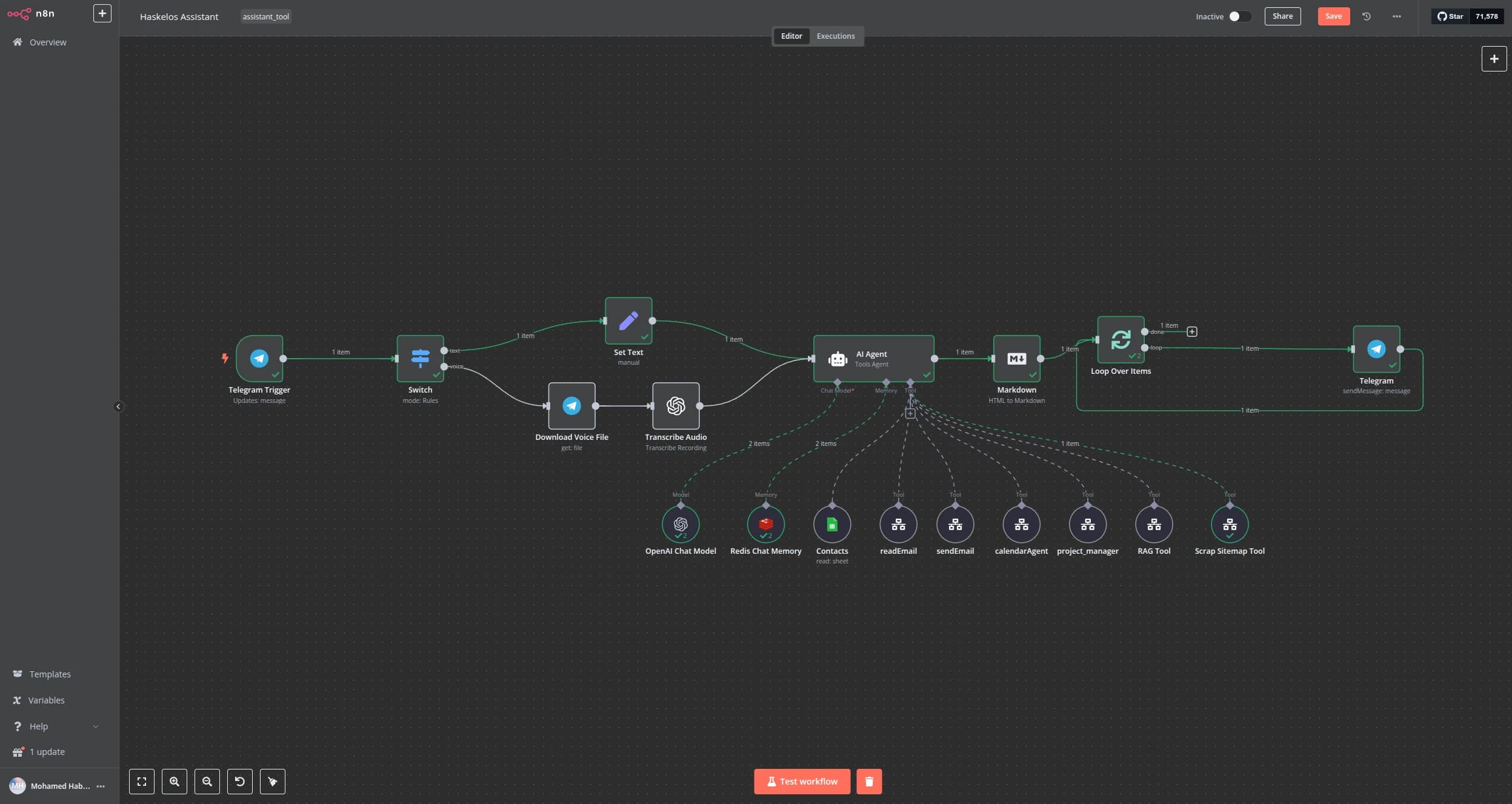
Why Your Organization Needs Factual AI Documentation
Documentation challenges are universal across industries. Technical professionals spend countless hours searching through fragmented information across multiple sources, whether it's financial regulations, healthcare protocols, or—as in my case—blockchain documentation.
Despite advances in AI like ChatGPT and Claude, enterprise users face a critical problem: these models often "hallucinate" or provide outdated information, making them unreliable for mission-critical work. Organizations need solutions that deliver factually accurate, verifiable answers derived from their own trusted documentation.
This article demonstrates a practical solution using n8n (workflow automation), Qdrant (vector database), and Crawl4AI (headless browser crawler) to create a Retrieval-Augmented Generation (RAG) system. While I'll use blockchain documentation as an example, this approach works for any technical documentation—from legal compliance to product manuals to internal knowledge bases. If you're interested in alternative RAG approaches, check out our guide on advanced RAG solutions with Flowise and LlamaIndex.
The Business Case for Documentation RAG
Before diving into implementation, let's clarify why organizations need this solution:
- Time efficiency: Documentation search often consumes 20-30% of technical professionals' time
- Reduced errors: Factual, source-verified responses prevent costly mistakes
- Knowledge democratization: Makes specialized information accessible to all team members
- Consistent answers: Ensures everyone receives the same information, unlike subjective human interpretations
- Scalability: Works across all documentation without increasing support staff
Unlike generative AI tools like ChatGPT, a RAG system only responds with information contained in your verified documentation sources, eliminating the risk of hallucination while maintaining the convenience of natural language queries.
Three Modular Workflows for Enterprise Documentation AI
The system uses three distinct n8n workflows, each handling a specific function. This modular approach ensures maintainability, extensibility, and reliability.
Document Discovery Through Automated Sitemap Crawling
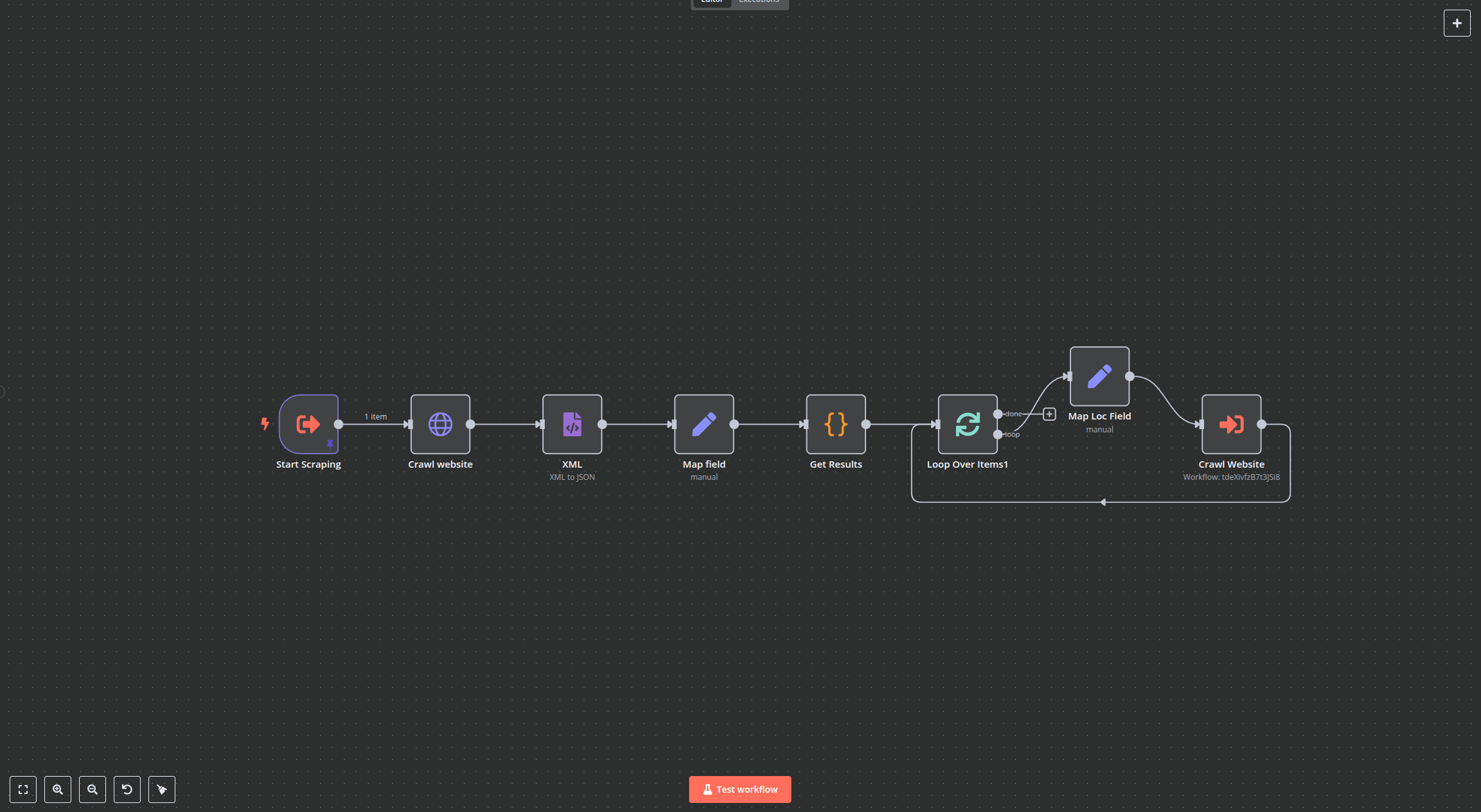
The initial workflow discovers all documentation pages through sitemap parsing:
- Fetches and parses XML sitemaps (common in most documentation platforms like Docusaurus, GitBook, etc.)
- Systematically extracts all URLs
- Creates a processing queue
- Triggers the "Document Processing" workflow for each URL
This approach ensures comprehensive coverage of all documentation without manual discovery.
Advanced Content Extraction and Semantic Embedding
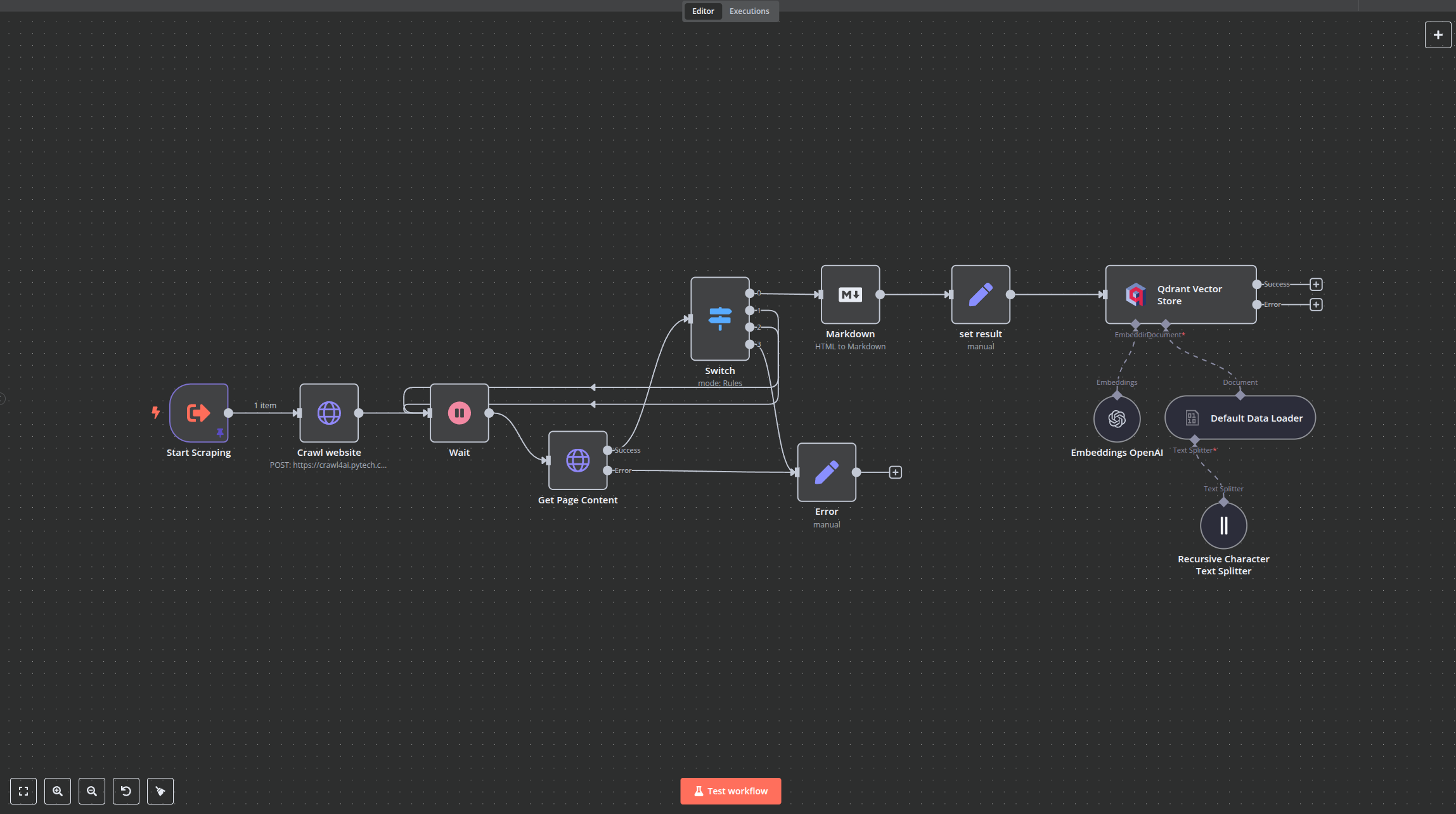
This workflow handles the extraction and transformation of each document:
{
  "urls": "https://example.com/documentation/section",
  "priority": 10,
  "crawler_params": {
    "headless": true,
    "page_timeout": 30000,
    "remove_overlay_elements": true
  },
  "extra": {
    "only_text": true,
    "bypass_cache": true,
    "process_iframes": true
  }
}
The workflow process:
- Crawl4AI renders the page including all JavaScript-based content
- Navigation elements, cookie notices, and other non-content items are removed
- The workflow converts HTML to clean markdown
- Content is chunked and embedded using OpenAI's
text-embedding-3-largemodel - Both text chunks and vector embeddings are stored in Qdrant
This approach works with modern documentation platforms that use JavaScript frameworks, interactive elements, and dynamic content loading—a critical advantage over simple HTTP scraping.
Intelligent Query Processing for Accurate Answers
The final workflow handles user interactions:
- Receives natural language queries from any interface
- Transforms queries into vector embeddings
- Retrieves semantically similar content from the vector database
- Uses retrieved content as context for an LLM response
- Delivers factually accurate answers with source references
Key enhancements:
- Conversation memory via Redis for context-aware follow-up questions
- Specialized prompt engineering for documentation-based responses
- Source attribution to enable verification
This approach fundamentally differs from generic AI assistants like ChatGPT or Claude, which may generate plausible-sounding but incorrect responses. By grounding every answer in your verified documentation, the system delivers enterprise-grade reliability.
Essential Technology Stack for Trustworthy AI
How RAG Eliminates AI Hallucinations
RAG addresses fundamental limitations of large language models:
- Knowledge cutoffs: Most models have training cutoffs (e.g., GPT-4's knowledge ends at a specific date)
- Hallucination risk: Models generate plausible-sounding but incorrect information
- Source attribution: Conventional LLMs can't cite specific sources for verification
- Domain-specific knowledge: Models lack specialized organizational knowledge
The RAG architecture solves these issues by:
- Retrieving relevant information at query time
- Providing this information as context to the LLM
- Instructing the model to use only the provided information
This creates responses that are factually grounded in your organization's specific documentation.
Vector Search for Intelligent Document Retrieval
Qdrant enables semantic rather than keyword-based search:
- Documents are represented as mathematical vectors in high-dimensional space
- Similar concepts cluster together in this space, even with different terminology
- Queries find the closest vectors by semantic meaning, not exact word matches
This semantic approach is critical for technical documentation where different terms often describe the same concept. For example, a search for "permission settings" might correctly return content about "access control" even without those exact words.
Setting up Qdrant is straightforward:
docker run -p 6333:6333 qdrant/qdrant
Visual Workflow Automation with N8N
n8n provides a visual, low-code environment for building complex workflows:
- Visual debugging: Real-time data flow monitoring
- Extensible design: Easy addition of new data sources or capabilities
- Enterprise integration: Connect to existing systems via APIs
- Scalability: Handles large documentation sets and high query volumes
The visual interface makes the system maintainable even by team members without deep programming expertise. For a comparison of n8n with other workflow automation tools, see our analysis of Langflow vs Flowise vs n8n vs Make.
Dynamic Content Processing with Crawl4AI
Crawl4AI is the leading open-source tool for AI-ready web crawling, specifically designed for LLMs, AI agents, and data pipelines. Unlike simple HTTP scrapers, Crawl4AI offers capabilities essential for modern websites:
- Full JavaScript rendering: Processes dynamic content in SPA frameworks like React or Vue
- Clean Markdown generation: Produces structured, AI-friendly content with accurate formatting
- Intelligent filtering: Uses heuristic-based filtering to remove noise and irrelevant parts
- Deep crawling strategies: Supports BFS/DFS/BestFirst strategies for comprehensive site coverage
- Media and iframe support: Extracts images, videos, and embedded iframe content
- Dynamic content handling: Simulates scrolling and waits for lazy-loaded elements
- Stealth mode: Avoids bot detection by mimicking real user behavior
Deployment options are flexible and secure:
# Basic setup
docker pull unclecode/crawl4ai:basic
docker run -p 11235:11235 unclecode/crawl4ai:basic

# Production with authentication
docker run -p 11235:11235 \
  -e CRAWL4AI_API_TOKEN=your_token \
  unclecode/crawl4ai:basic
Crawl4AI offers a FastAPI server with JWT authentication and is designed for scalable cloud architecture.
Beyond Blockchain: Industry Applications for Documentation AI
While this system was initially developed for blockchain documentation, it's applicable across industries:
- Financial services: Regulatory compliance documentation
- Healthcare: Clinical protocols procedures
- Legal: Case law and regulatory frameworks
- Manufacturing: Technical specifications and procedures
- Software: API documentation and implementation guides
- HR: Policy handbooks and procedures
- Customer support: Knowledge bases and product documentation
The workflow remains identical—only the documentation source changes. Each industry benefits from the same improvements in accuracy, efficiency, and accessibility. For a broader perspective on AI integration across business operations, read our strategic guide for AI integration in enterprises.
Seamless Integration Options for Enterprise Systems
Enterprise Messaging Platforms Integration
The most common implementation is integration with messaging platforms like Slack, Microsoft Teams, or Telegram:
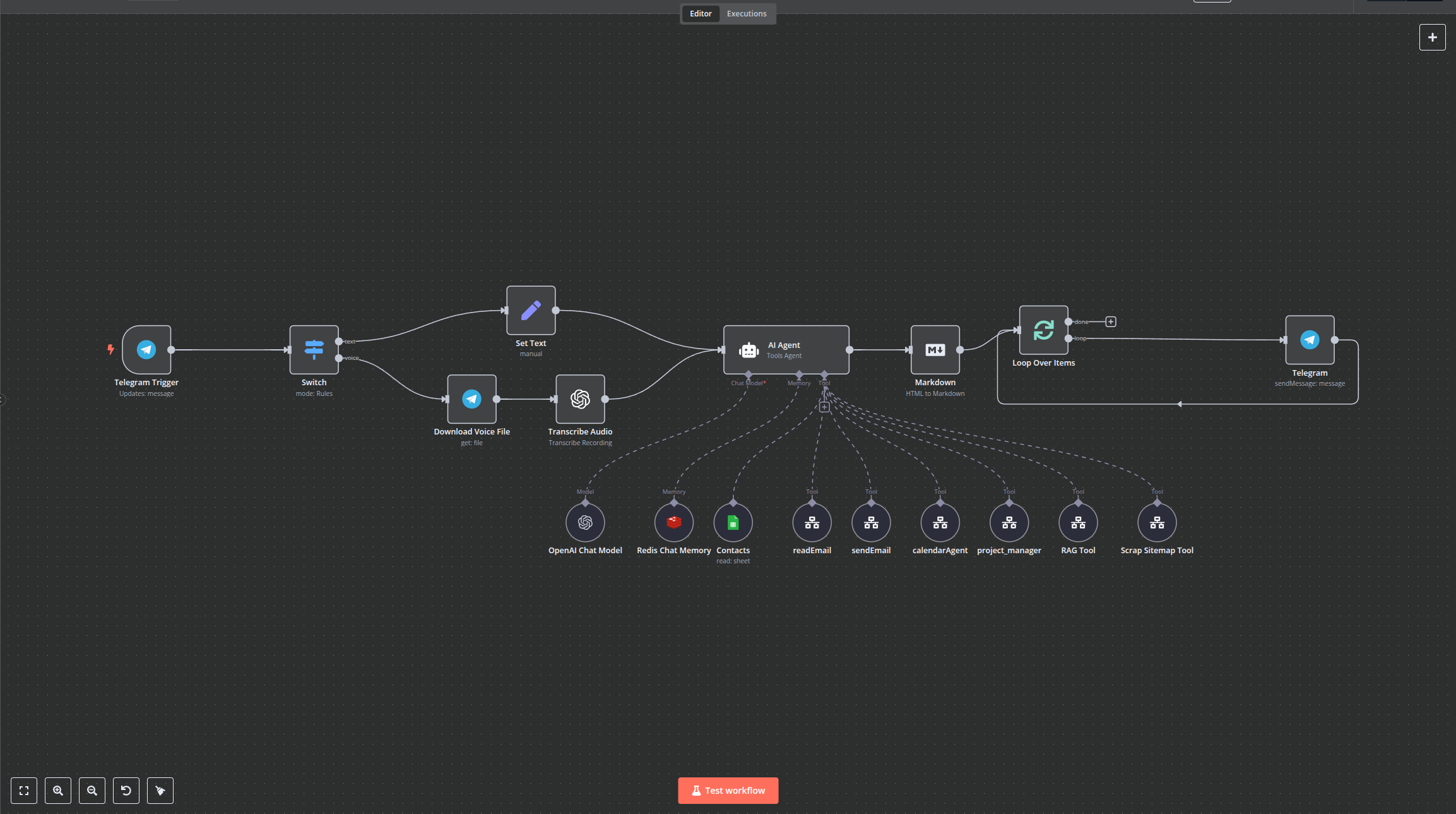
This workflow:
- Receives messages from users
- Routes questions to the appropriate knowledge base
- Returns factual, cited answers
Voice transcription can also be added for hands-free operation.
Enterprise API Integration Options
For enterprise applications, exposing the RAG system as an API enables integration with:
- Internal portals
- Customer support systems
- Development environments
- Mobile applications
This allows seamless embedding of documentation intelligence throughout your organization's workflow.
Quantifiable Business Impact of Documentation AI
Organizations implementing documentation RAG systems typically see:
- 40-60% reduction in time spent searching documentation
- 25-30% decrease in support tickets
- 15-20% faster onboarding for new team members
- Significant reduction in errors from misinterpreted documentation
The system becomes increasingly valuable as documentation volume grows, making it particularly effective for large enterprises with extensive knowledge bases.
Transform Your Documentation into Intelligent Knowledge
As AI adoption accelerates across industries, the challenge isn't simply implementing AI—it's implementing trustworthy AI. The RAG system outlined here represents a practical solution for organizations that need both the convenience of conversational AI and the reliability of verified information.
Unlike general-purpose AI assistants, this system ensures every response is grounded in your organization's trusted documentation. It combines the best of AI natural language capabilities with the assurance that answers reflect your specific, authoritative content.
By implementing this approach, organizations can transform static documentation into an interactive knowledge base that's accessible, accurate, and aligned with enterprise requirements for factual verification.
Sources: