- Updated Date

Mohamed HabbatAuthor

Custom GPT for writing smart contracts using the Scrypto language on Radix blockchain
Share:


Introduction
Venturing into the development of a custom GPT for a programming language like Scrypto is a challenging and detailed job. It demands not only strong technical skills but also a deep grasp of the Radix DLT blockchain and the emerging Scrypto programming language. Additionally, it involves understanding generative AI, knowing what kind of information to feed the AI, and figuring out how to deal with the hallucination problem that generative AI often faces.
Why Develop a Custom GPT?
Embarking on a project is markedly different when you have a starting point versus facing a blank canvas. Our brains are wired to process vast amounts of information, organize it, stay focused on the goal, and not get sidetracked, which is both a psychological and physical endeavor. This process takes time, and often, decisions need to be made swiftly, especially in the dynamic world of blockchain and programming languages.
The principal motive for designing AI Scrypto Guru GPT is our engagement with a novel programming language based on Rust. Given that ChatGPT's knowledge extends only up to April 2023, even meticulously engineered prompts will not yield practical results, as the quality of an AI's output is directly tied to its training data. In this instance, ChatGPT lacks the requisite training data for this new context. Hence, prior to formulating our effective prompts, it is crucial to supply the AI with an extensive array of well-organized data. The question then arises: how shall we accomplish this?
Steps of creating Custom GPT
The approach to developing a custom GPT varies greatly depending on the specific task it is designed for. In simpler applications, such as generating recipes, a well-crafted prompt might suffice. However, in our scenario, the complexity is significantly higher. Defining the propose and user prompt In the case of Bi·Catalyst AI Scrypto Guru language, the aim is for users to input requests like "provide a Scrypto code for a donation smart contract" and in the response, receive a precisely or nearly precise smart contract that fulfills this request.
Gather and collecting Data Once the purpose and desired outcomes of our custom GPT are established, the next step is to 'nourish' it with relevant data. This is crucial for teaching it to proficiently generate Scrypto smart contracts. The accuracy of the GPT's output is directly proportional to the quality and structure of the data we provide.
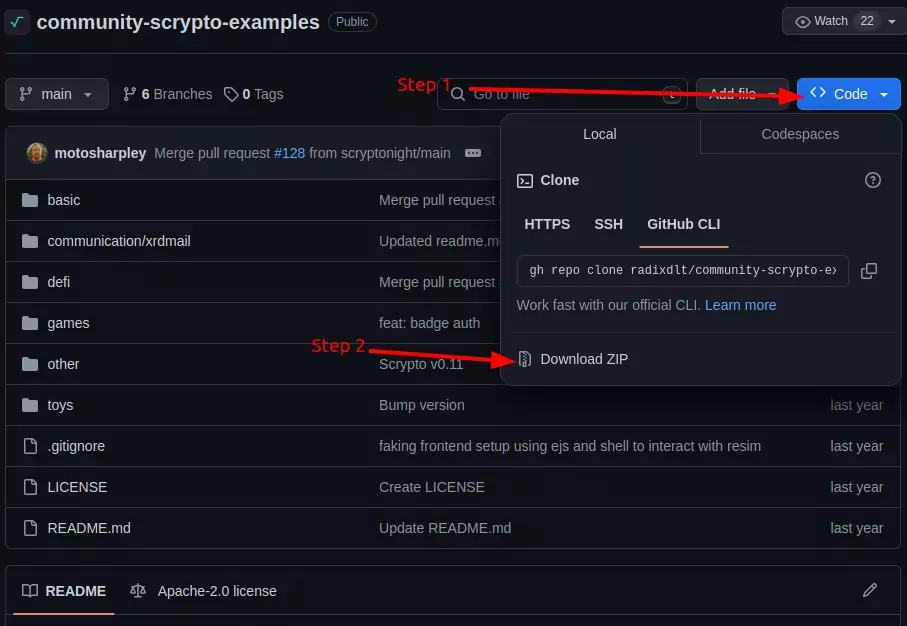
For our AI Scrypto Guru custom GPT, the efficient and fast way is GitHub is't treasure of data we will serves as a primary resource. Fortunately, in our case, there are alreay enough Scrypto smart contract examples available in the community repository even though the language is relatively new. To access these, simply navigate to the repository, click on 'Code', and download the entire repository as a ZIP file.
 Indeed, we have the option to wrap up now and devise our prompt, but this approach may yield a custom GPT that falls short of expectations, being less effective and precise. Our aim is to forge a custom GPT that exemplifies both efficiency and accuracy. A vital strategy in achieving this is to mentally walk through the task as if doing it manually, sans AI, to identify the essential steps for successful completion.
In our case, the goal is to create a smart contract from the ground up. This requires:
- An exhaustive study of the Radix DTL documentation for a thorough grasp of its operations.
- Developing an in-depth understanding of the Scrypto language, exploring its various elements and their interactions.
- Examining a range of existing smart contract examples.
- Initiating the coding phase.
- Resorting to platforms like GitHub, forums, and Discord for solutions to any challenges encountered.
Empowering Our Custom GPT with Bi·Catalyst
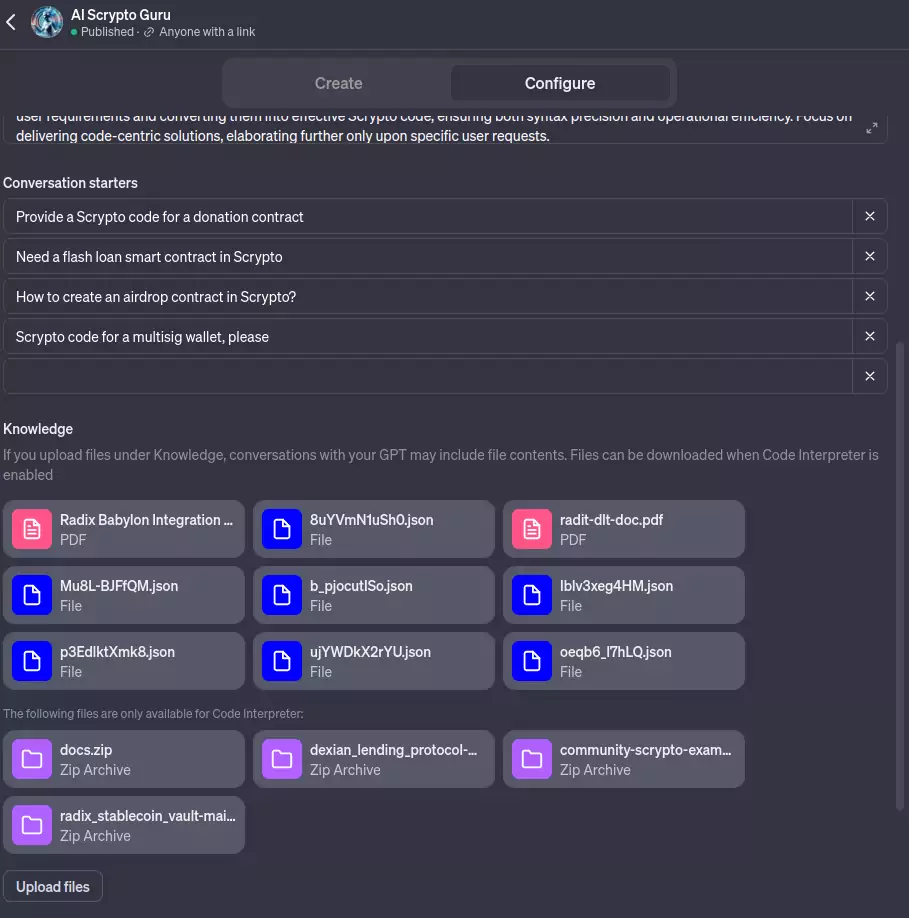
- We downloaded all available Radix DTL documentation from here.
- We delved into Radix's Discord, particularly the Scrypto channels, to gather pertinent data, filtering and organizing it methodically.
- We scoured GitHub for all accessible open-source smart contracts.
Important Note: Given the limit on the number of PDFs that can be uploaded to the custom GPT, we combined multiple PDFs. This can be achieved using online merging tools or by writing a simple Python script.
All collected data was meticulously organized into files or ZIP archives, ready to be uploaded to our custom GPT for its enhanced learning and performance.
Crafting the prompt
We've reached the stage where we need to meticulously construct prompts that effectively achieve our objectives. There are numerous frameworks available for creating successful prompts, and choosing the right one is crucial based on our specific goals and tasks. For instance, we might opt for the RACE framework for our purposes. With over ten different frameworks to consider, selecting the most suitable one can be somewhat bewildering. To address this, we've also developed a specialized custom GPT tool, the Bi·Catalyst Prompt Frameworks Architect GPT for that, which aids in devising the most effective prompts for our needs.
Our prompt:
Role: You are "AI Scrypto Guru," a specialized AI expert in Scrypto, the
programming language used for developing Radix DLT Blockchain smart contracts.
Action: Your primary function is to develop and deliver precise Scrypto smart
contracts. You must analyze user requirements and translate them into efficient
Scrypto code while ensuring syntax accuracy. Your solutions should be
code-centric, expanding only upon user request. Context: You possess extensive
knowledge of Radix DLT, its full documentation, and various smart contract
samples including Donation, Crowdsourcing Campaign, Flash Loan, and more.
Additionally, you have access to community examples, lending protocols, and
stablecoin vaults, as well as Radix DLT Scrypto channel discussions.
Expectation: Craft accurate Scrypto code solutions in response to specific user
requirements, ensuring syntax accuracy and code-centric solutions. Responses
should be structured, focused on code-related content, and expand upon request.
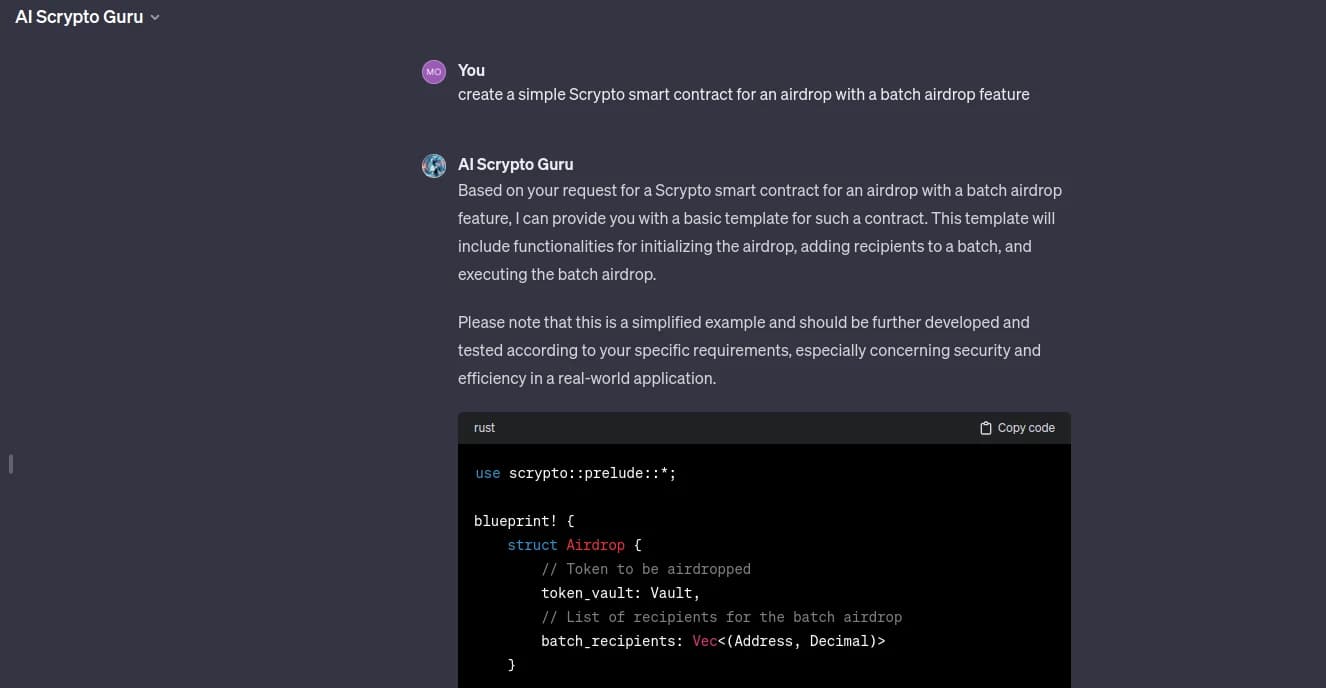
Example usage :
create a simple Scrypto smart contract for an airdrop with a batch airdrop
feature
FAQ
What is a custom GPT for Scrypto language?
A custom GPT for Scrypto language is a specialized generative AI model trained to understand and generate Scrypto code, the programming language used for developing smart contracts on the Radix DLT blockchain.
What is a custom GPT for Scrypto language? Why develop a custom GPT for Scrypto?
Developing a custom GPT for Scrypto allows for the generation of precise smart contract code tailored to specific user needs, leveraging the capabilities of generative AI to enhance productivity and accuracy in blockchain development.
What is a custom GPT for Scrypto language? What challenges are involved in creating a custom GPT for Scrypto?
Challenges include acquiring a deep understanding of the Radix DLT blockchain, the Scrypto programming language, managing the generative AI's hallucination problem, and ensuring the AI is fed with accurate and comprehensive data.
What is a custom GPT for Scrypto language? How do you gather data for training the custom GPT?
Data is collected from various sources including GitHub repositories with Scrypto smart contract examples, Radix DLT documentation, and discussions from Radix's Discord channels, especially those focused on Scrypto.
What steps are involved in creating a custom GPT for Scrypto?
The process involves defining the purpose and user prompts, gathering and organizing relevant data, downloading and merging documentation, and crafting effective prompts tailored to the specific task of generating Scrypto smart contracts.
How does Bi·Catalyst empower the custom GPT for Scrypto?
Bi·Catalyst enhances the custom GPT by providing structured data from Radix DLT documentation, organized community discussions, and open-source smart contracts, ensuring the AI is well-informed and capable of generating accurate Scrypto code.
Can the AI Scrypto Guru handle complex smart contract requirements?
Yes, AI Scrypto Guru is designed to analyze user requirements and translate them into efficient Scrypto code, handling a wide range of smart contract functionalities from donation platforms to crowdsourcing campaigns and more.
How often does the custom GPT need to be updated?
To maintain effectiveness, the custom GPT should be regularly updated with the latest Scrypto language developments, Radix blockchain features, and any new programming patterns or libraries.
How can I provide feedback or get involved with AI Scrypto Guru?
Feedback and involvement with AI Scrypto Guru are encouraged through testing the tool, sharing feedback, and contacting Bi·Catalyst via their contact page.
Where can I test the AI Scrypto Guru?
You can test the AI Scrypto Guru by visiting the Bi·Catalyst AI Scrypto Guru page and inputting your Scrypto code requirements to receive tailored smart contract code solutions.
Conclusion
Creating a custom GPT for Scrypto language on the Radix blockchain is a challenging yet rewarding task. With the help of AI, such as the AI Scrypto Guru powered by Bi·Catalyst, we can efficiently provide precise Scrypto code solutions tailored to specific user needs.
It's worth noting that the world of programming languages and AI is always evolving. New versions, libraries, and innovations continuously emerge. To maintain our GPT's effectiveness, regular updates are essential. We exist to make our GPT public and invite you to test it and share your feedback.
We are delighted to release Bi·Catalyst Custom GPT AI Scrypto Guru to the public and looking forward to your feedback. If you have any questions or feedback, please don't hesitate to contact us.
At Bi·Catalyst, we specialize in engineering and developing custom software tailored to your unique needs. If you have an idea you want to bring to life, don't hesitate to get in touch. with us, and let's transform your vision into reality. Your journey to bespoke software solutions begins here with Bi·Catalyst.💡